
Artificial Intelligence Statistics 2025
AI (Artificial Intelligence) Statistics for 2025
Artificial Intelligence (AI) is reshaping industries at a rapid pace. And the AI market is projected to reach $757.58 billion by 2025. Furthermore, over 90% of leading companies are investing in AI to enhance their operations.
Let’s check out facts and figures about the Artificial Intelligence industry worldwide, the AI industry in the United States, the adoption of AI by businesses and in different industries, AI usage statistics, its impact on jobs worldwide, and more in this article.
Top Artificial Intelligence Statistics 2025: Editor’s Pick
Discover top AI statistics of 2025, curated insights, and trends shaping the future of technology.
Global AI Industry Statistics
- AI market size is estimated to reach $757.58 billion in 2025.
In 2024, the size of the AI Market was recorded to be $638.23 billion, and the market is estimated to grow by 19.20% in 2025.
Further, the AI Market Size is expected to reach $3,680.47 billion by the end of 2034.
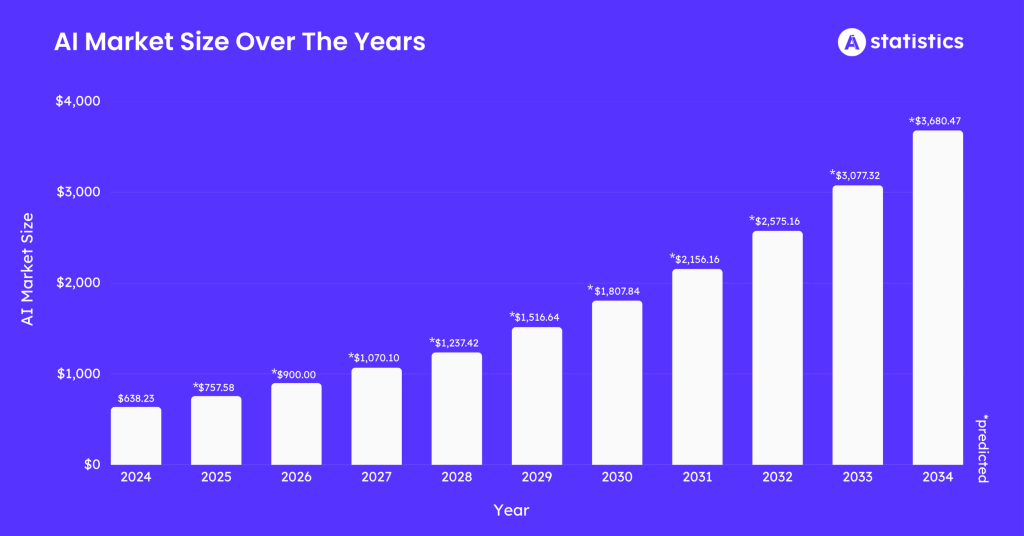
Here is a table displaying the AI Market Size over the years.
| Year | AI Market Size (In Billions) |
| 2024 | $638.23 |
| 2025 | *$757.58 |
| 2026 | *$900 |
| 2027 | *$1,070.10 |
| 2028 | *$1,237.42 |
| 2029 | *$1,516.64 |
| 2030 | *$1,807.84 |
| 2031 | *$2,156.16 |
| 2032 | *$257.16 |
| 2033 | *$3,077.32 |
| 2034 | *$3,680.47 |
*-Projected values
Sources: Precedence Research
- Generative AI Market Size is estimated to reach $109.37 billion in 2030.
The global generative AI market, valued at USD 16.87 billion in 2024, is projected to reach USD 109.37 billion by 2030, growing at a robust CAGR of approximately 37.9%.
- The machine-learning market size is expected to reach USD 282.13 billion by 2030.
The global machine learning market was valued at USD 55.80 billion in 2024 and is projected to reach USD 282.13 billion by 2030, reflecting a CAGR of 30.4% between 2025 and 2030.
The rapid expansion of artificial intelligence (AI) as a transformative technology is driving significant changes in how businesses and individuals operate. You can also read more about AI in business statistics.
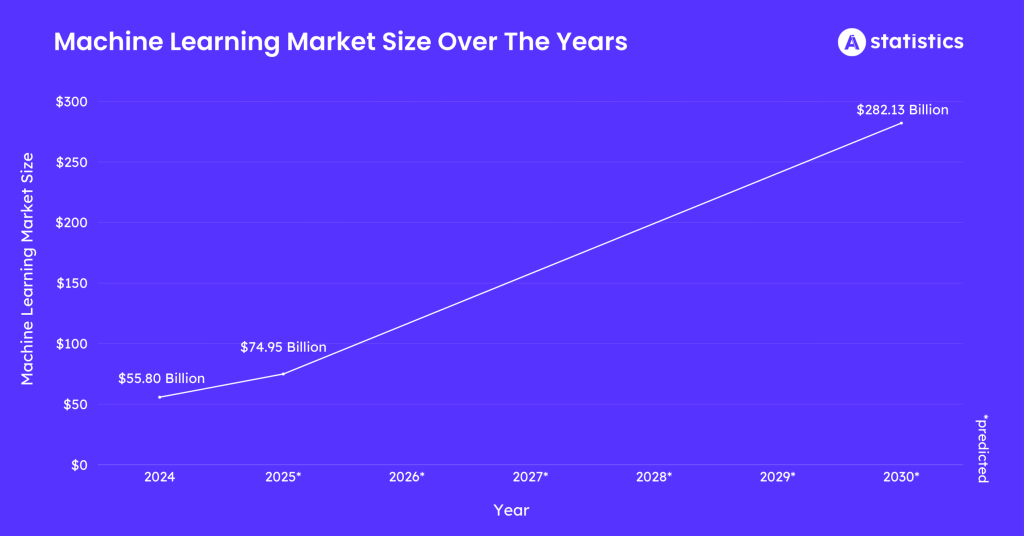
The following table displays the machine learning market size over the years.
| Year | Machine Learning Market Size (Billion USD) | Notes (Based on Grand View Research Data) |
| 2024 | 55.80 | Base Year Estimated Value |
| 2025* | 74.95 | Forecasted Value |
| 2026* | Not Available | The market is anticipated to grow at a CAGR of 30.4% from 2025 to 2030. |
| 2027* | Not Available | The market is anticipated to grow at a CAGR of 30.4% from 2025 to 2030. |
| 2028* | Not Available | The market is anticipated to grow at a CAGR of 30.4% from 2025 to 2030. |
| 2029* | Not Available | The market is anticipated to grow at a CAGR of 30.4% from 2025 to 2030. |
| 2030* | 282.13 | Projected Revenue Forecast |
*- projected values
Source: Grand View Research
- The market size of computer vision is estimated to reach $71.36 billion by 2030.
The Computer Vision Market was valued at approximately $19.82 billion in 2024. With a robust CAGR approaching 20%, the market is projected to reach a value of over $58 billion by 2030.
Source: Grand View Research
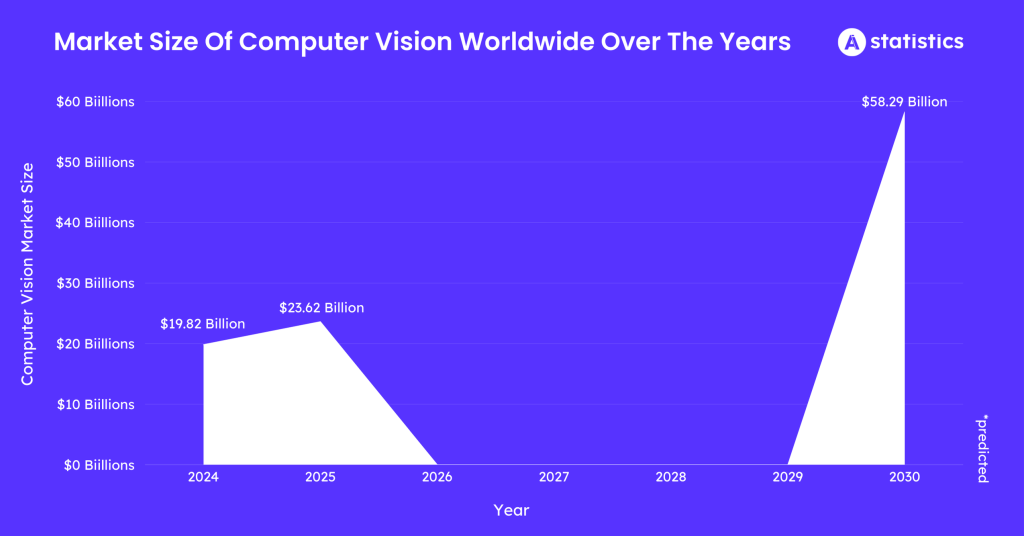
Here are further details about the market size of computer vision worldwide over the years.
| Market | Market size of computer vision worldwide (Billion USD) |
| 2024 | 19.82 |
| 2025 | 23.62 |
| 2026 | N/A |
| 2027 | N/A |
| 2028 | N/A |
| 2029 | N/A |
| 2030 | 58.29 |
*-projected Values
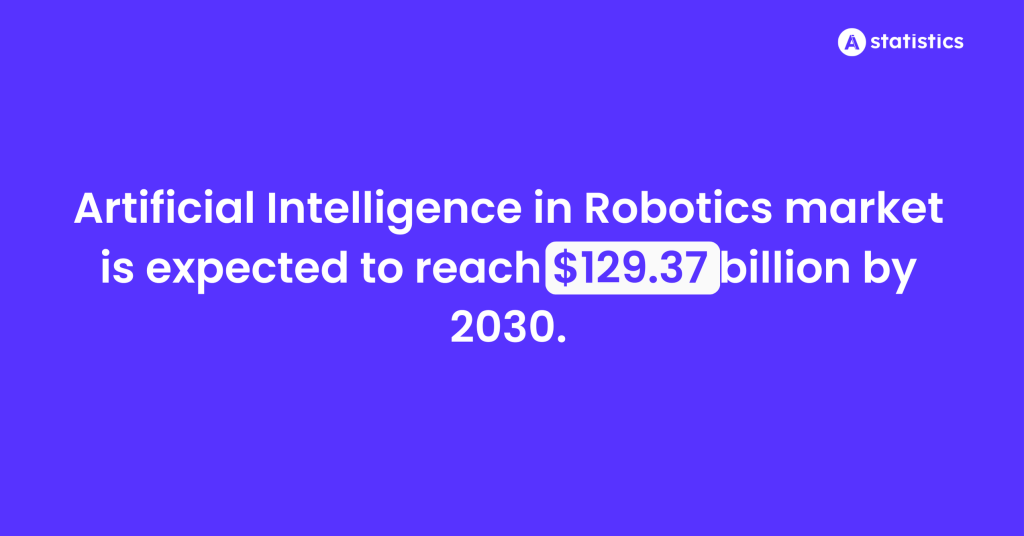
- Artificial Intelligence robotics market was valued at USD 129.37 billion in 2030.
The Artificial Intelligence in Robotics market was valued at USD 13.23 billion in 2023.
Furthermore, its total revenue is projected to expand at a CAGR of 38.5% from 2024 to 2030, reaching approximately USD 129.37 billion by the end of the forecast period. This is driven by the demand for automation across manufacturing, healthcare, and logistics.
Source: Maximize Market Research
AI Industry in the United States
- The AI Market in the United States is estimated to reach $851.46 billion in 2034.
The U.S. artificial intelligence (AI) market was valued at $146.09 billion in 2024 and is projected to reach approximately $851.46 billion by 2034, growing at a CAGR of 19.33% from 2025 to 2034.
The market’s expansion is being driven by the increasing adoption of AI to enhance business efficiency and productivity.
(Source: Presedence Research)

Here is a table displaying the AI market size in the United States over the years.
| Year | Market Size (USD Billion) |
| 2024 | 146.09 |
| *2025 | 173.56 |
| *2026 | 201.01 |
| *2027 | 242.40 |
| *2028 | 292.89 |
| *2029 | 353.66 |
| *2030 | 415.81 |
| *2031 | 496.79 |
| *2032 | 594.02 |
| *2033 | 710.89 |
| *2034 | 851.46 |
*- Projected Values
- The market size of generative AI in the United States was $4.06 billion in 2023.
The Generative AI market size in the United States was approximately $4.06 billion in 2023 and is projected to reach $5.26 billion in 2024.
The market is expected to grow at a Compound Annual Growth Rate (CAGR) of 36.3% and reach a projected value of $33.78 billion by the end of 2030.
(Source)
- The machine-learning market in the United States is expected to reach $59.30 billion in 2030.
Besides, the machine learning market in the United States was valued at $6.49 billion. The projected growth rate from 2024 to 2030 is 37.2%.(Source)
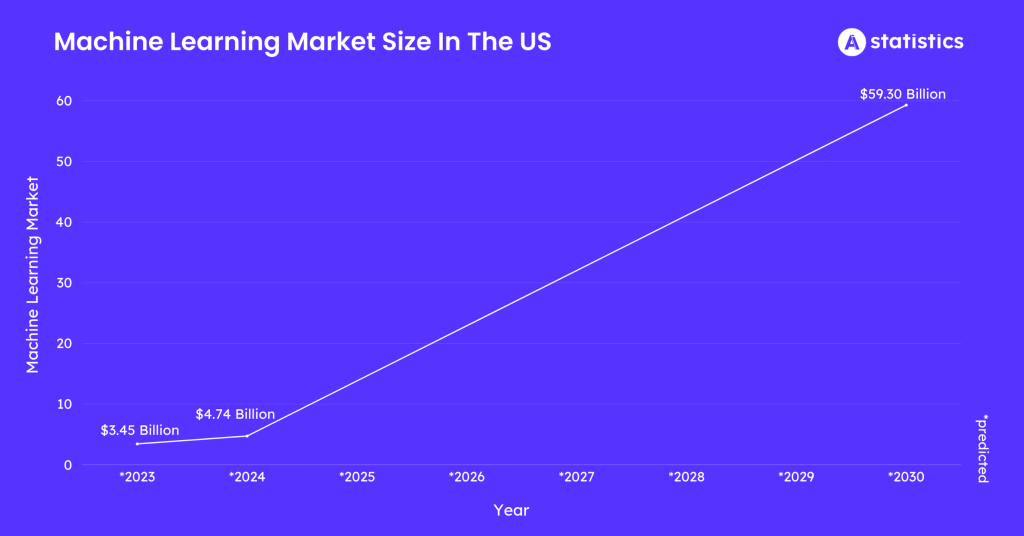
The following table displays further details about the machine learning market in the United States.
| Year | Machine Learning Market Size In The US (In Billions) |
| 2023 | 3.45 |
| 2024 | 4.74 |
| 2025 | – |
| 2026 | – |
| 2027 | – |
| 2028 | – |
| 2029 | – |
| *2030 | 59.30 |
*- Projected Values
AI Adoption Statistics
- 55% of the residents in the United States stated that they regularly use AI, and 44% stated that they do not regularly use AI. (Source)
- 88% of organizations worldwide report using AI in at least one business function, a significant increase from 78% just a year prior. (Source)
- 64% of organizations report that AI is enabling their innovation and driving competitive differentiation.
- The percentage of global companies using AI has jumped to 78% in 2025, up from 55% in 2023. (Source)
- 9 in 20 people use AI to respond to people through text or emails.
The single most common use of AI by Americans is Searching for information (e.g., via Google’s AI-powered answers), with 60% reporting this interaction. (Source)
Here are further details about the ways people use AI:
- Respond to people via text/email: 45%
- Plan travel itinerary: 38%
- Answer financial questions: 43%
- Craft an email: 31%
- Write a social media post: 25%
- Prepare for a job interview: 30%
- Write a social media post: 25%
- Summarize complex or long copy: 19%
- 60% to 66% of businesses have implemented some form of process automation, with 88% of organizations using AI in at least one business function (Source)
- Current AI models are projected to increase annual U.S. labor productivity growth by up to 1.8% over the next decade. (Source)
- 85% of Fortune 500 companies utilize AI for their businesses.
- AI has the technical capability to automate activities accounting for about 57% of U.S. work hours today.
- The United States leads global AI engagement and corporate AI deployment, with 88% of organizations worldwide (where the U.S. is the primary driver) using AI in at least one function. (Source: McKinsey & Co)
- China leads the world in the sheer number of Generative AI users (515 million in early 2025) and is focusing on the rapid scale-up of real-world AI applications. (Source: McKinsey & Co)
- 21% of U.S. workers say at least some of their work is done with AI, an increase from the previous year. (Source)
- Current AI systems have the technical capability to perform tasks equivalent to 11.7% of the total U.S. wage value, representing a significant shift in job function potential. (Source)
- 59% of the global workforce will require reskilling or upskilling by 2030 (Source)
- Over 88% of business leaders are prioritizing the acceleration of AI adoption and automation to meet consumer expectations and gain a critical competitive advantage.
AI Adoption by Industry
- AI in the Banking market is projected to grow to $34.58 billion in 2025.
The total AI spending nearly doubled from 2023 to 2024 (from 154 billion to $279 billion, and is projected to triple again by 2025, driven by the need for Generative AI tools and infrastructure.
While Banking was the top spender in 2023, the Software and Information Services industry is now often ranked highest due to its massive investment in developing and integrating AI into its products.
At the same time, the AI in the Retail market is projected to reach $14.03 billion in 2025.
Furthermore, the Healthcare sector is rapidly increasing its spending, moving into the top 5, fueled by AI for diagnostics, drug discovery, and operational efficiency.
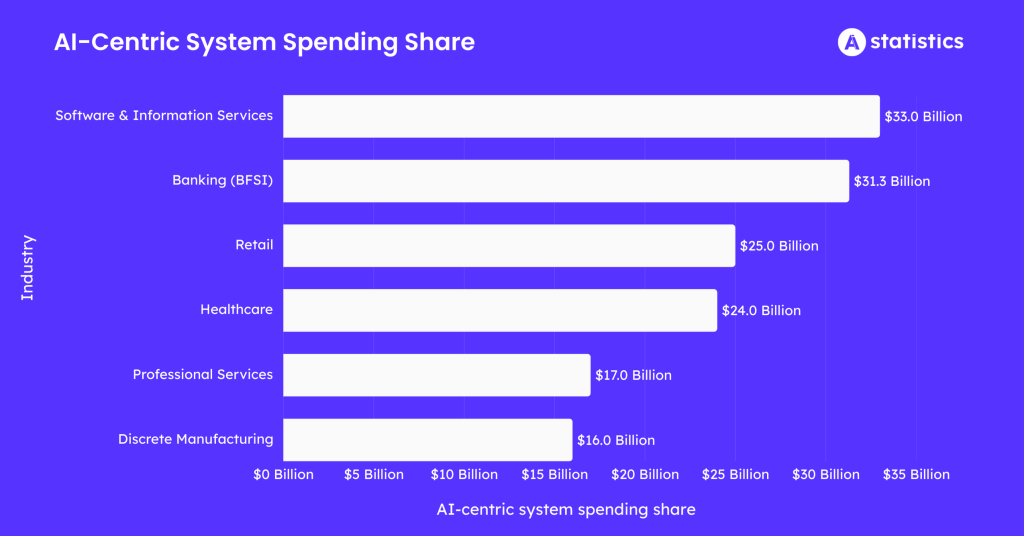
Here is a table displaying the estimated spending of different industries on AI-centric systems worldwide.
| Industry | Estimated 2024 Spending |
| Software & Information Services | $33 billion |
| Banking (BFSI) | $31.3 billion |
| Retail | $25 billion |
| Healthcare | $24 billion |
| Professional Services | $17 billion |
| Discrete Manufacturing | $16 billion |
- Nearly 90% of telecom companies report regularly using AI in at least one business function. (Source: McKinsey & Company)
- 3% of Communications Service Providers (CSPs) have chatbot integration in production or close to it.
- AI can reduce customer service response times by over 50% and cut network downtime by up to 40%. (Source)
- 64% of large retailers had already adopted AI, with another 22% exploring it. This suggests the planning phase is largely over. (Source)
- 42% of companies report using Generative AI specifically in Marketing and Sales, while 71% of all organizations are now regularly using GenAI in at least one business function. (Source: McKinsey & Company)
- 83% of marketers admit that AI frees up their time so they can focus on more strategic or creative aspects of their roles.(Source)
- 70.8% of all workplace AI users are reported to be using ChatGPT. (Source)
- More than half of marketers (56%) claim GenAI content outperforms human content in their experience. (Source)
- Demand for Health professionals and STEM professionals is expected to grow by 17% to 30% by 2030. (Source)
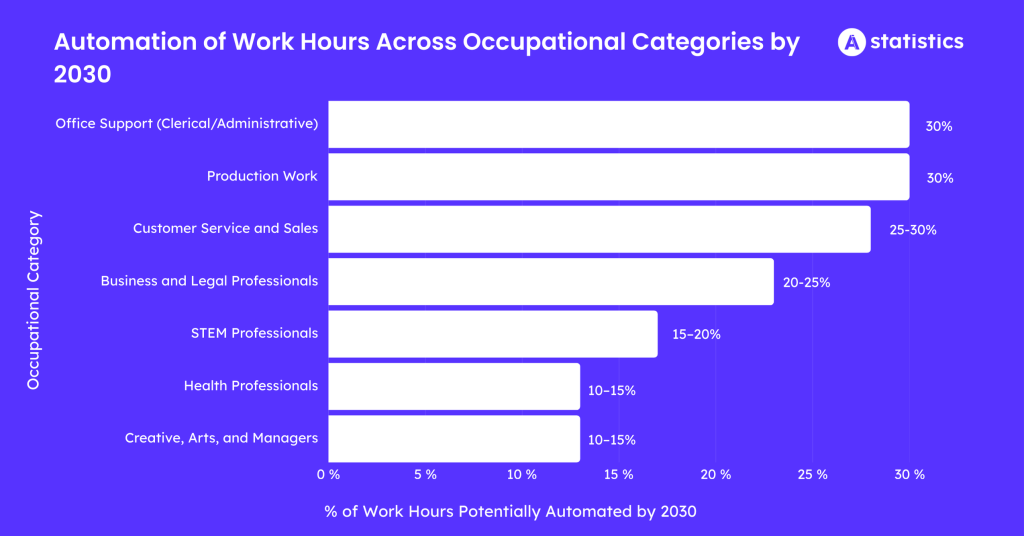
- The occupations with the highest decline in demand by 2030 are Clerical & Administrative Workers and Production Workers (e.g., up to 30% of current work hours could be automated). (Source)
- AI is expected to cut teachers’ time on administrative work by 40%
This table shows the percentage of current work hours that could be automated across various occupational categories by 2030 in a scenario of accelerated AI adoption.
| Occupational Category | % of Work Hours Potentially Automated by 2030 | Implication (Automation Type) |
| Office Support (Clerical/Administrative) | Highest Risk: 30%+ | High Displacement Risk |
| Production Work | High Risk: 30%+ | High Displacement Risk |
| Customer Service and Sales | High Risk: 25–30% | High Displacement/Augmentation Risk |
| Business and Legal Professionals | Medium Risk: 20–25% | High Augmentation Potential |
| STEM Professionals | Medium Risk: 15–20% | High Augmentation Potential |
| Health Professionals | Low Risk: 10–15% | High Augmentation Potential |
| Creative, Arts, and Managers | Low Risk: 10–15% | Focus on Augmentation |
- 9 in 10 marketers are confident in learning, understanding the working, and adapting the usage of new AI tools. (Source)
- Companies leveraging conversational marketing (chatbots) have reported a 70% increase in marketing qualified leads (MQLs) and 30% more leads in 30 days. (Source)
- 7 in 10 marketers believe AI can outperform humans in key marketing tasks, cementing the revolutionary outlook. (Source)
- 60% of customers define an “immediate” chat response as being 10 minutes or less. However, for AI Chatbots specifically, the expectation is instant, with 59% expecting a response under 5 seconds. (Source, Source 2)
AI Usage Statistics
- Almost 71% of the organizations stated that they have some to little expertise in generative AI.
71% of companies reported using Generative AI in at least one business function as of 2025, meaning the percentage with absolutely “no expertise” is much smaller than 35%. (Source)
On the other hand, the latest reports show GenAI adoption is mainstream, with 93% of organizations exploring or enabling GenAI capabilities. This suggests the “no expertise/not exploring” group is a minimal percentage. (Source)
- 77% of the currently used devices include some form of AI.
- 64% of business owners believe that AI will boost the productivity of their employees.
- 64% of people in the United States said that they are comfortable using AI for entertainment recommendations, while 50% are comfortable with the facial recognition technology on their personal devices.
The following table displays the percentage of people in the United States who are comfortable using artificial intelligence in different fields in the United States as of 2023 and 2022.
| Daily tasks | 2023 | 2022 |
| Entertainment recommendations on streaming services (e.g., movies and TV series I might like) | 64% | 72% |
| Target advertising on social media | 48% | 51% |
| Autonomous, unmanned ride-share vehicles such as Uber or Lyft | 36% | 35% |
| Online chat with an automated doctor for routine health questions | 43% | 49% |
| Federal government benefits processing (e.g., social security, Medicare, veterans’ benefits) | 42% | 49% |
| Facial recognition technology on my phone or other personal devices | 50% | 57% |
- Level 3+ autonomous vehicles are projected to account for 10% to 20% of total global vehicle sales by 2030. However, 60% of new vehicles sold will have at least Level 2 (driver assistance) autonomy. (Source)
- 32% of consumers (general population) use the voice function daily to search for something they’d normally type. (Source)
- The AI skills gap is a major concern for 55% of leaders. (Source)
- 88% of digital marketers now use AI in their day-to-day tasks, with content generation (SEO/keyword research) being a primary use case.
| Internal Business Process | Updated AI Usage Percentage (~2025) |
| Process Automation | 65%+ |
| Search Engine Optimization (SEO) Tasks / Content Creation | 65%+ |
| Improve Production Processes (Operations/Supply Chain) | 55–60% |
| Aggregate and Analyze Business Data | 55%+ |
| Write Code / Software Development | 60%+ |
| Internal Communications, Plans, and Reports | 45–50% |
| Minimize Safety Risks (e.g., Predictive Maintenance, Fraud) | 40–50% |
| Idea Generation | 38%+ |
| Write Website Copy | 45%+ |
Impact of AI Adoption on Jobs
- 62% of workers globally are worried about AI-driven displacement. (Source)
- Approximately 41-47% of employers worldwide are either considering or intending to reduce their workforce due to AI adoption.
- 49% of all tasks in the broad Legal Occupations category are susceptible to GenAI automation.
- 41% of employers worldwide intend to reduce their workforce because of AI adoption in the next five years. (Source)
- 1 in 3 businesses could replace employees with AI by the end of 2025. (Source: McKinsey & Company)
- Existing AI systems already have the technical capacity to replace work completed by 11.7% of the US workforce, amounting to $1.2 trillion in wages. (Source)
- AI is likely to eliminate 85 million jobs by 2025. However, it will also create 97 million new jobs, resulting in a net gain of 12 million jobs.
- With the adoption of AI, 375 million employees may have to change their careers.
- Nearly 9 in 20 businesses are planning to reduce their workforce due to the integration of AI technologies into their business.
- Multiple surveys confirm that Gen Z and Millennials express the highest levels of concern (often 35% to 40% “very concerned”).
- By 2030, 1 in 10 nursing tasks are expected to be automated.
- GenZ was most concerned that AI tools like Chatgpt may replace their jobs, whereas less than 4 in 10 Boomers were concerned that AI may replace their jobs.
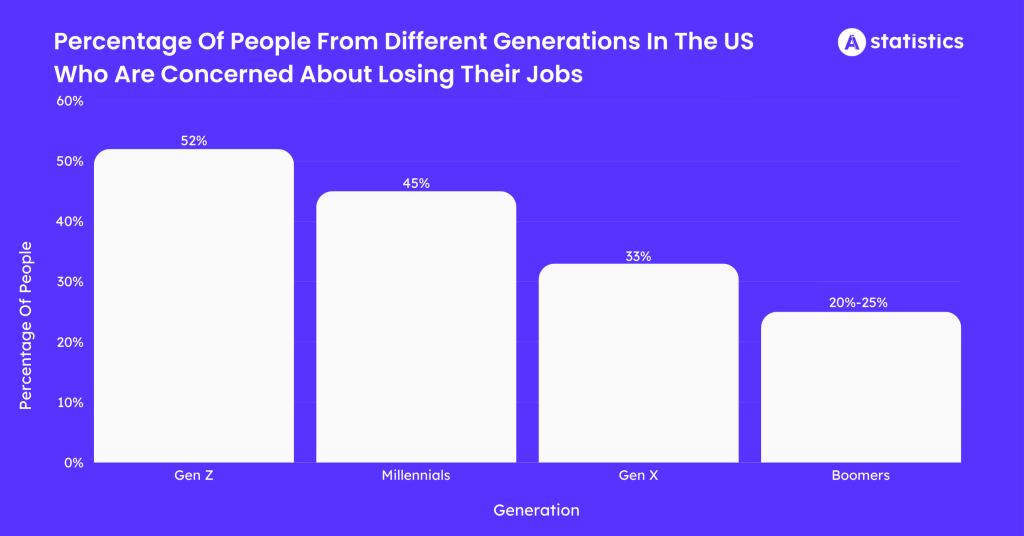
Here is a table displaying the percentage of people from different generations in the United States who are concerned about losing their jobs.
| Generation | Percentage Concerned |
| Gen Z | 52% |
| Millennials | 45% |
| Gen X | 33% |
| Boomers | Not explicitly cited in the article’s core findings, but consistently lower (e.g., 20%–25% range in similar surveys). |
Source:D2L
Views of Consumers on AI Adoption
- 74% of internet users prefer using chatbots for simple questions. (Source)
- 75% of consumers still believe chatbots cannot handle complicated requests (Source)
- Over 60% of companies are actively using AI to personalize customer experiences and resolve issues faster (Source: McKinsey & Company)
- 33% of consumers fully trust brands with this kind of data.
- 8 in 10 adults in the United States are worried that cyber attackers may use AI for cyber crimes, whereas 78% of the adults in the country are concerned that AI may be used for identity theft.
- 78% of business leaders believe that the benefits of AI adoption are significantly higher than the risks of adoption. (Source)
- 56% of the companies stated that one of the biggest risks of adopting generative AI is ‘inaccuracy.’ Still, only 32% of the companies have adopted the system to take care to such risks. (Source)
- Approximately 37% of businesses view the overall cost of adopting new technology as a substantial obstacle to their strategic plans (Source)
Here is a table displaying the challenges enterprises face in technology adoption.
| Challenge | Key Percentage |
| Achieving Measurable Value | 85% – 88% (Total Challenged) |
| Changing Operating Model | 85% – 86% (Total Challenged) |
| Cost of Adopting New Technology | 84% – 86% (Total Challenged) |
| The AI ROI Paradox (General Context) | ROI takes 2 to 4 years (vs. 7-12 months expected) |
| Talent/Skills Gap (General Context) | Top 5 AI challenge for 2025 |
Table data: Source 1, Source 2, Source 3
- 22% of the executives stated that one of their primary concerns about generative AI Adoption is data privacy.
- According to 82% of business leaders, it’s okay to use AI tools when responding to colleagues.
Conclusion: Over Half OF US Residents Regularly Use AI
The usage of AI among major corporations is virtually universal, with over 99% of Fortune 500 companies having integrated AI technologies into their operations.
Globally, approximately 88% of businesses now employ AI in at least one business function.
Driven by rapid investment and scaled deployment, the global Artificial Intelligence market size is projected to reach around $757 billion in 2030.
At the pace we’re moving forward with tech, we’re excited to see how AI shapes the future!